JP Visser is an orthopedic technical center in Aruba. Its staff sell and fit orthopedic aids at the counter, take on custom work for the workshop, and keep stock that comes from suppliers abroad. Sales billed to AZV, the national health insurance, need the referral and the insurer's authorization on record.
It was Grapeseed's first project. We took Open Source Point of Sale (OSPOS 3.3.4), a PHP register and inventory system, and shaped it around how the center works. The first version was running by June 2021, and we kept shipping to it through 2024.
The brief
Insurance on every sale
A sale billed to AZV needs the requester, the request number, the medical indication, the treating specialist and the authorization with its approval date, on the record and on the invoice.
Work that isn't a sale yet
Custom insoles, shoes and braces are measured, ordered or made, and delivered later. The team needed to see where each order stands.
Stock bought abroad
Items come from suppliers abroad, priced in their own currency and with import duties on top. The counter needs both the retail price and the AZV price.
The front door
Staff sign in at grapeseed.jpvisser.com. In March 2024 we redesigned the sign-in page with Tailwind CSS: the center's logo, a username, a password and a reCAPTCHA, next to a Grapeseed panel.
The counter
Counter staff live in the register, so that is where the insurance work goes. Every sale carries the requester, the request number, the medical indication, the specialist, whether it is billed to AZV, the authorization number and its approval date. Picking a customer shows their AZV number, doctor and date of birth next to the cart. The payment types follow how the center is paid: AZV Payment and AZV Owing next to cash, Maestro and bank transfer, each with a variant for the patient's own contribution (eigen bijdrage). Since June 2024 every sale needs a customer.
The workshop
Custom work doesn't leave the counter the same day. The Orders module, which stock OSPOS doesn't have, tracks it per patient: what was ordered, who placed it, and its status (waiting for approval, placed, received, cancelled or taken from inventory) with the date it was started, placed and received.
The stock
Every item carries its AZV price next to the retail price, its rack, size and colour, and up to three suppliers, each with its own raw cost and currency. The landed price and the import duties (invoerrechten) are recorded on the item too. Purchase orders, also not in stock OSPOS, go to one supplier with shipping costs and can be received in part. In February 2024 we added fuzzy search to purchase orders.
A weekly stock email
In January 2024 we added a weekly low-stock report by email. A weekly job in the app collected every item below its reorder level and sent it to a small mail service we wrote in TypeScript with Bun, Express and React Email, running on Google Cloud Run and sending through Resend. The email listed each item with its current amount and reorder level, and linked to the full report. It ran until January 2025.
Built with

Open Source Point of Sale
The base: OSPOS 3.3.4, a register, inventory and reporting system on CodeIgniter 3 and PHP, extended with the modules and fields described above.

MySQL
The database behind the register, the orders, the stock and the reports.

jQuery and Bootstrap
The interface of the register and the back office, as OSPOS ships it.

Tailwind CSS
The sign-in page redesign of March 2024.

TypeScript
The mail service, run with Bun and Express.

React Email
The weekly inventory report email, sent through Resend from Google Cloud Run.
What came next
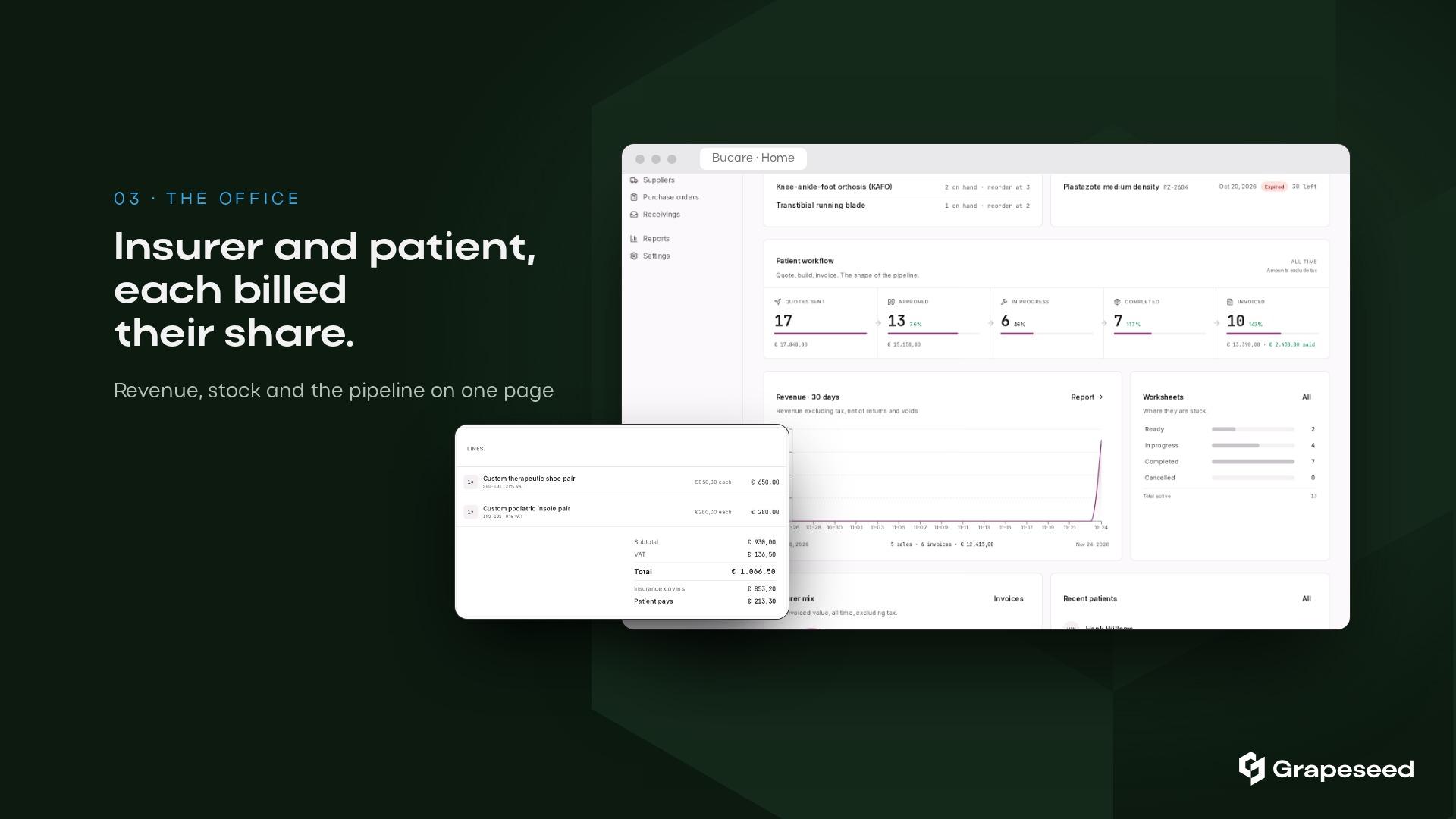
The system is still live at the center in November 2026. Its successor is Bucare, our own practice software for orthopedic centres, built on Next.js and Supabase to take over every workflow in this one. It launched on 30 October 2026. That story is told in the Bucare case study.